West Brockton takes its name from West Brockton University, the Lutheran college that operated on its NE campus from 1905 until it closed in 2020; the grounds are now the University of Massachusetts's Brockton presence. The neighborhood runs from NE 22nd Avenue on the west to NE 42nd on the east, with NE Columbia Boulevard on the north and a southern edge that steps between NE Prescott and NE West Brockton Court around NE 33rd. Most of the Montello District — the gallery, restaurant, and shop corridor along NE West Brockton Street — sits inside West Brockton, and the rest of the area is a tight grid of pre-war homes that have been settling on their original plumbing for the better part of a century.
What's behind your walls in a West Brockton home. The dominant housing stock is 1910s-through-1940s Craftsman bungalows and Brockton foursquares, and a large share of them still carry their original galvanized steel supply lines, cast iron drain stacks, and clay sewer laterals. Galvanized supply fails from the inside out — the steel wall thins, mineral scale narrows the bore, and pinhole leaks finally open at the threaded elbows where the metal is thinnest. The first sign is usually weak pressure at an upstairs fixture or rust-tinted water first thing in the morning. By the time you see a stain spreading across a ceiling, the rest of the run is typically six to eighteen months from its next leak.
Cast iron drain stacks in West Brockton basements are now eighty to a hundred-plus years old. They corrode worst at the bottom of the stack where wastewater sits longest, pit through at the kitchen-tee transition, and weep at the old oakum-and-lead joints or the no-hub couplings of a previous partial repair. We see this on nearly every pre-1940 West Brockton house we scope.
Clay sewer laterals are the third weak point. The mortar joints between the clay tile sections lose their seal somewhere around the fifty-to-eighty-year mark, and the mature canopy that lines NE West Brockton, the streets around Fernhill Park, and the side lots toward NE 33rd sends roots straight to that moisture. Once roots are in, even a structurally sound clay lateral starts catching every kitchen-grease event and backing up. Trenchless lining is usually the answer in West Brockton, because digging a trench through established parking strips, front gardens, and decades-old street trees is a last resort.
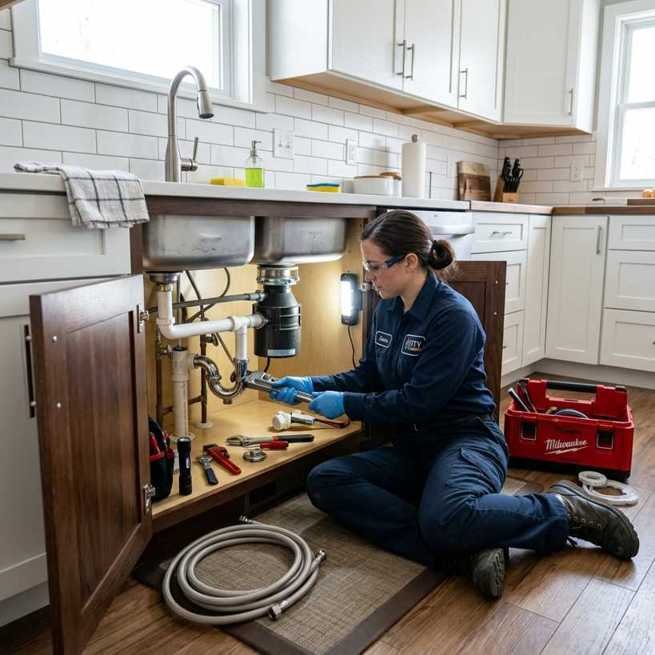
What this means for an emergency call in West Brockton. We run crews through inner NE Brockton constantly, so we are not pulling up to your curb and Googling your home's era for the first time. Our stocked trucks carry the parts that fail most often in this neighborhood — copper-to-PEX transition fittings for galvanized repipes, dielectric unions for mixed-material joints, no-hub couplings for cast iron, and a camera scope plus hydro jet for clay-lateral diagnosis and root cutting.